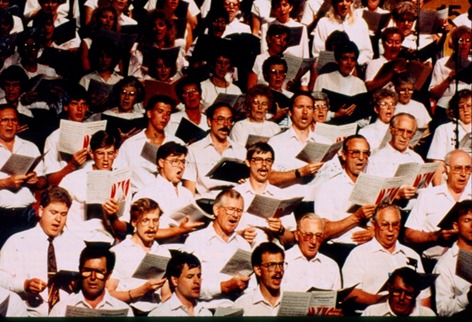
Many choirs here in the UK have an ageing membership.

Not to put too fine a point on it, but if you don’t bring in new members regularly, your choir will eventually die out!

Many choirs here in the UK have an ageing membership.
Not to put too fine a point on it, but if you don’t bring in new members regularly, your choir will eventually die out!
Often, when I’m teaching a song, a man might ask to sing the tune, or a woman might ask to sing the bass.

I usually say no, as I don’t like mixing men’s and women’s voices in the same part. Why is that?


A woman came up to me last Saturday and said “I like coming to your workshops because there are always lots of men”.
Little did she know that only a week before there had been 45 women and just one man enrolled on the workshop!
For the first time in over 13 years I will soon be starting a choir from scratch. And I’m asking for your help!

I’ve written a whole series in the past about how to start your own community choir, and I will be taking a lot of my own advice on board (time to put my money where my mouth is!).
But the nut I’ve been unable to crack is to recruit a truly representative set of people from my local community: in age, gender, race, culture, background, education, disability, etc. In short, a real community choir.
The sad fact is that most choirs in the UK don’t reflect a true cross section of society.
They majority are made up of white women in their 50s and older and often don’t represent the racial, cultural or gender mix of the community they’re based in. How can we change this?
I’ve written on the subject of choir membership and recruitment before.
I’ve realised that there is no easy answer to recruiting a representative set of people from your local community! So I’m asking for your help.
Do you have any ideas or experience of recruiting successfully from right across your local community? Would you like to share your solutions with us? Please drop by and leave a comment.
It seems to me that we can break down the problem as follows.
First you need to be clear what your aims are and then find the right words to explain that clearly to prospective choir members. It may be that you have to use different language for the different groups that you’re trying to attract. Each group will use different language and have different shared points of reference.
Then you have to get this information in front of the relevant people. It’s probably no good putting an advert in the local press to attract 16-year-olds, and it’s no good handing leaflets out after a live pop concert if you’re looking for older singers. You’ll need to take the word to the people you want to attract. That may mean identifying places where groups gather. For example, colleges, adult education classes, churches, cultural clubs.
I’ve pointed out before that when a prospective new choir member walks into their first choir session, they want to see a lot of people like themselves. Otherwise they will feel that they don’t belong and wont’ come back.
If you have a single man or just one 21-year-old, that’s just not going to work. You’ll need to make sure there are large enough sub-groupings within your choir to attract more similar people.
It may not be possible to start from scratch with a truly representative group of singers. It may be that your description, publicity sources, venue, etc. may have to be tailored for each particular group. You can then combine them at a later stage.
For instance, you could start a regular choir (which will probably be older women), a men’s choir, a choir at the local Afro-Caribbean centre and a youth choir. Once these are up and running, you could have a joint concert (involving a couple of joint songs where everyone needs to rehearse together), then gradually amalgamate all the different groups into one choir.
On the face of it, that seems like a lot of work! It may be that you simply don’t have the time or resources to go the whole hog (I know I don’t!), so please, please write in with your own solutions and let’s see if we can all crack this particular nut together.
This is inspired by a post from January 2007 about Minor Chords, the first women’s ensemble I ran.

How do mixed choirs and single-sex choirs differ, if at all? I was partly inspired to write this by an article on ChoralNet (Are women’s choirs different?). There are clearly some differences, but are they important and does one kind of choir have an advantage over the other?
In 2001 I set up a women’s singing ensemble called Minor Chords (a weak pun based on the fact that all members are also in the bigger choir Woven Chords). The group consisted of 12 women who had the singing skills and commitment to meet alternate Saturdays for three hours to tackle more complex and difficult material than the main choir.
I didn’t hold formal auditions, but required members to be able to hold a part on their own. Over the years the standard of the group rose considerably and it became harder and harder to find suitable new material which was sufficiently challenging.
In 2007 I decided I wanted to raise the bar even higher and work with a group to develop performance skills rather than simply teaching songs each session. I disbanded Minor Chords and formed a new group (by audition this time) called Vox Mondiale. It was still a women-only group.
Over the next couple of years I helped develop the group’s confidence and performing skills. Last year I took off the training wheels and handed over the group to its members to run without me.
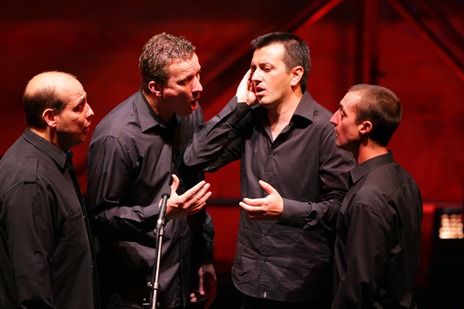
In 2004 I decided to run a men-only workshop in an attempt to get more blokes singing. Over the next few years this became an annual fixture attracting between 20 and 40 men each year. It was a great opportunity to do some of those real blokey songs from Georgia mixed with a few sea shanties, chain gang songs and songs from other male traditions such as Corsica and South Africa.
I’ve also been involved in a couple of workshops where we’ve invited both men and women, but then split into gender groups to learn songs separately. We began with a joint warm up and taught a song to everyone, then split up for the rest of the day. At the end of the workshop the women sang what they’d learnt to the men, and vice versa.
Over the years I have noticed certain differences when running a men-only or women-only workshop.
When it’s men-only, there tends not to be any chit chat when lunch is being prepared (and no chat whilst songs are being learnt either!). One year a bloke who usually sings with a mixed choir pointed this out: “Quiet, isn’t it?”. The savoury course tends to be pies and quiches bought from Morrison's, whereas the sweet course is home-made cakes (made by the men themselves). Washing up and tidying up is quick and efficient.
With women-only groups there is plenty of animated conversation during breaks. In fact, it’s hard to get them back after tea breaks! There were always lots of cakes in the break when I used to run Vox Mondiale. In fact, I think it became a little bit competitive and the singing was maybe just an excuse to come and eat cake!
In a women’s workshop, the savoury course for lunch tends to be home-made healthy salads, etc. whereas the sweet course is almost always shop-bought gateaux and cheesecakes. Washing up is effective, but takes time (with all the chat going on).
Just my observations!
In the Balkans it is typical for girls to form close friendships at school from a very early age. They will sing together with their friends in groups that will sometimes last a lifetime. Imagine how well they get to know each other’s voices and abilities!
Male groups of singers tend to be based around occupation (in Britain at least): coal miners, police, fishermen, etc.
All my community choirs have been mixed (when I took over Woven Chords it was women-only because the previous director thought men were too loud and disruptive!). Although men have always been in the minority.
There is nothing really to compare with a full-on four part (SATB) arrangement of a song with a meaty bass part. It’s nice to vary the diet every now and then so we do occasionally slip in a women-only or men-only song.
... of being in a mixed choir:
... of being in a single-sex group
... of being in a mixed choir:
... of being in a single-sex group
Does the gender of the choir or workshop leader make a difference?
Bill Henderson of the Forres Big Choir reckons that the reason they have roughly 50% men in their mixed choir is that they have a male and a female leader.
Simon said that although his choir was lead by a husband and wife team, the husband made jokes at the men’s expense whilst the wife was more supportive and encouraging.
When the choir leader is of a different gender to the singer, there can be problems with pitching and giving starting notes (see Singing the same note – differently!). This can easily be overcome though. Women in my choir are used to automatically singing an octave higher than the note I give out. But when Michael Harper came to give a workshop (he’s a respected counter tenor) he gave the notes at pitch and the women freaked out when they couldn’t sing an octave higher than him!
Have you had experience of being in (or leading) both a mixed choir and a single-sex choir? Did you notice any differences? Does the gender of the choir leader make a difference? Can you think of any other issues that I’ve left out? Do drop by and leave a comment.

