Showing posts with label listening. Show all posts

Monday, August 18, 2025

Your complete guide to learning songs by ear

For thousands of years, cultures across the globe have passed songs on orally to the next generation. This requires much repetition as well as active listening.

However, this is no longer a dominant part of many cultures today. What is the best way to learn a song by ear?

Monday, February 10, 2025

Why silence is important to singers, singing and choir leaders

I came across an interesting article the other day: Quiet, please! The remarkable power of silence – for our bodies and our minds.

It got me thinking about how vital silence is for singers, singing and choir leading.

Monday, September 23, 2024

Always listen more loudly than you sing

It always surprises me when singers sing so loudly that they can’t hear the rest of the choir.

photo by Constantin Tacke

It’s hearing the other harmony parts that keeps you on the straight and narrow, and it’s where the singing pleasure lies.

Monday, May 13, 2024

Learn to harmonise using your favourite domestic appliance!

I was singing along with my electric shaver the other day – as you do.

I realised that it was a great way to explore harmonising in the privacy of your own home.

Monday, June 26, 2023

In a choir, it’s not about singing loud vs. soft – it’s about balance

I’ve written before about How to know how loud you should sing in a choir.

photo by Malingering

But as a choir member you are working as part of a team, so it’s not entirely up to you. It’s all about balance.

Monday, January 09, 2023

5 reasons why every choir concert should include at least one a cappella song

Many choirs use instruments or backing tracks to accompany their singing.

photo by Andrea Pineda

But I believe that you should always programme at least one a cappella song in every concert. Here’s why.

Monday, October 10, 2022

When men and women sing the same harmony part

Often, when I’m teaching a song, a man might ask to sing the tune, or a woman might ask to sing the bass.

I usually say no, as I don’t like mixing men’s and women’s voices in the same part. Why is that?

Monday, July 11, 2022

Vocal exercises to help singers tune into a cappella harmony

I thought I’d share a few vocal exercises that I use to help singers tune in to a cappella harmony. 

I often integrate these into the warm up sessions to get people listening more closely before we move on to learning harmony songs.

Monday, June 28, 2021

Skills you’ll need to brush up when your choir rehearses again in person

Here in England, we’re limited to a maximum of six singers rehearsing indoors.

photo by allan harris

When restrictions are finally lifted (in three weeks we hope), many choral skills will have gone rusty over the last year or more.

Monday, April 05, 2021

How to sing a drone of staggering beauty

A drone is a note continuously sounded throughout most or all of a song.


But singers have to breathe, so how can this be achieved?

Monday, September 21, 2020

Singing with masks: advice for choir leaders

I wrote last week about how wearing masks might affect singers and how they can overcome any obstacles.

This week I want to look at the impact on choir leaders.

Monday, June 22, 2020

Singers listen with their eyes as well as their ears

I've been trying to sing against a recording of two other people singing different harmony parts.


I found it almost impossible to pitch accurately because I couldn't see them.

Monday, April 20, 2020

The sound of silence – rediscovering the art of listening

With far fewer people around at the moment, I am starting to hear things that I don’t normally notice.


It made me realise that in our usually busy daily lives, many of us have lost the art of listening. It’s time to reconnect with the world.

Monday, November 11, 2019

The long and the short of it: height differences in singing groups

I was teaching a group about what might affect the vocal blend when singing harmony in small groups.


Somebody pointed out that it’s much easier if everyone is the same height. This got me thinking …

Monday, September 16, 2019

How to squeeze singers into a rehearsal space that’s too small

It’s not something that happens out of choice, but sometimes we end up with too many singers for the rehearsal space available.


photo by Bryan Ledgard

Here are some ideas on how to deal with the situation.

Monday, August 12, 2019

Stopping singers from zoning out when saying something important for the hundredth time

Nobody likes to hear the same old stories and jokes time and again.


photo by James Brooks

It’s the same with instructions you give to your choir. How do keep stop people zoning out, even though you need to say the same thing week after week?

Monday, May 27, 2019

Having a “no music day” can improve your music-making

I’ve just returned from a week away. During that time I heard virtually no music and didn’t sing a single note.


It got me thinking about how having a break from music can reinvigorate our music-making practice.

Monday, March 04, 2019

Learning songs by ear: what should you do while other parts are being taught?

When a harmony song is being taught by ear, you can find yourself not singing whilst other parts are being taught.


Rather then zoning out or getting bored, there are plenty of things you can do which can help your learning. Here are some of them.

Monday, December 17, 2018

Have you become too dependent on your choir leader? You might be denying your own abilities

I’ve been noticing something interesting recently: when I move away from a part when I’m teaching them a song, they tend to fall apart.

Leaning_on_a_table

Since I’m not actually doing anything for them at this point, I wonder what’s going on.

Monday, November 12, 2018

How to work with a mixed group of music readers and non-readers

I always teach songs by ear. As a member of the Natural Voice Network, our ethos is to make singing accessible to as many people as possible. This means we never assume any prior musical experience or knowledge.

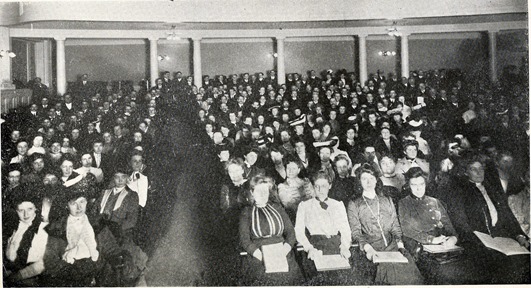
Handel and Haydn society 1893

But, sometimes there are music-readers in my singing groups who ask for the sheet music. How can you accommodate these demands whilst keeping the work accessible to everyone?